

A facial toner can be one of the simplest steps in skincare. Yet its ingredient list may be anything but simple: water, humectants, acids, fragrance, preservatives and botanical extracts.
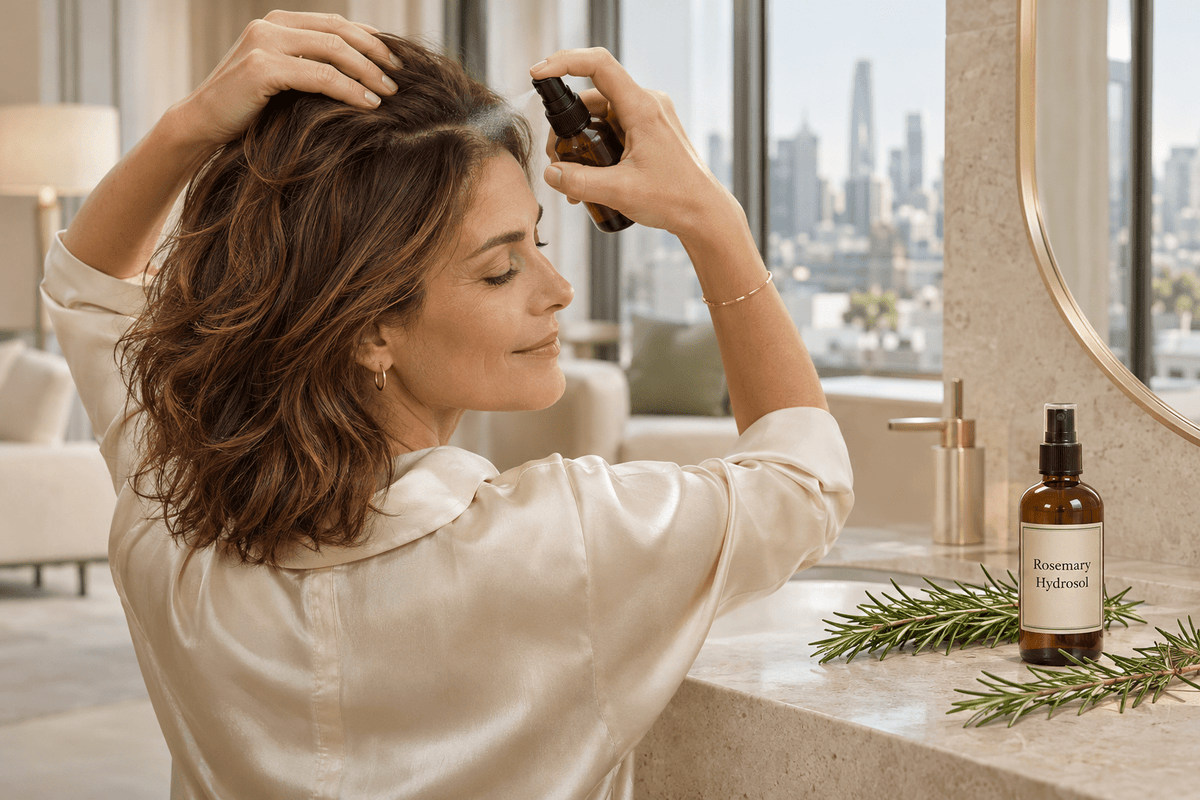
A pure hydrosol offers another approach. Distilled from plants, it brings a naturally complex botanical composition into a product with just one ingredient on the label. The same bottle can become your daily toner, a facial mist or a freshly prepared compress.
Rose, geranium, lavender, Roman chamomile, cornflower, peppermint and wild carrot seed hydrosols each have a place in facial care. Choosing between them begins with understanding what your skin needs.
What does a facial toner do?
Toner is a liquid usually applied after cleansing and before serum or moisturiser. Its purpose depends on the formula.
Hydrating toners contain ingredients such as glycerin or hyaluronic acid. Exfoliating toners use acids, including glycolic, lactic or salicylic acid. Astringent formulas are intended to reduce the feeling of excess oil.
Toner is an optional step, but the right product can leave skin feeling refreshed and comfortable after cleansing.
A hydrosol can perform this toning role too. The difference lies in its composition and how it is produced.
Why consider a hydrosol instead?
If your toner leaves your skin tight, persistently stinging or visibly red, its formula may not suit you.
Alcohol-rich products can feel drying. Exfoliating acids may irritate when used too frequently. Fragrance, preservatives and botanical extracts can also cause individual reactions.
Preservatives protect water-based cosmetics against contamination, and a well-formulated toner can be an excellent product. However, when you want to simplify your routine, a pure hydrosol offers a clear alternative.
You choose a single botanical distillate, without added perfume, alcohol or other ingredients, provided that is what the label confirms. This makes it easier to understand what you are applying and to introduce one botanical at a time.
What is a hydrosol?
A hydrosol, also called a hydrolat, is the aromatic water obtained during distillation of plant material with water or steam.
As the vapour cools, it condenses. Some aromatic compounds collect in the essential oil, while others remain in the water. Their differing solubility gives the hydrosol a composition of its own. [1,2]
Adding essential oil to water does not reproduce this process.
A pure hydrosol may list only one ingredient, such as Rosa Damascena Flower Water. Inside, however, is a mixture of naturally occurring plant compounds.
One ingredient, a complex composition
Analyses brought together in a 2024 review in Molecules identify compounds including phenylethanol, geraniol, citronellol and nerol in different rose hydrosols. Lavender hydrosols have been found to contain linalool, linalool oxides and borneol, among other constituents. [1]
The proportions vary with the species, growing conditions, plant material and distillation process. This is why botanical identity and production quality matter.
Len and Shirley Price also explore the chemical diversity of distilled plant waters in Understanding Hydrolats, treating them as distinct aromatic products with individual characteristics. [2]
Those differences extend to their smell. Some hydrosols are floral; others are herbal, earthy or unfamiliar. A hydrosol does not necessarily smell like the corresponding flower or essential oil.
What does research tell us?
Research has explored the antioxidant and antimicrobial activity of various hydrosols, alongside their potential as cosmetic ingredients. Much of this work is laboratory-based, with a smaller body of research involving people. [1]
For example, the Molecules review describes research on several hydrosols, including lavender, assessing topical tolerability and recovery of experimentally irritated skin. [1]
Michel Faucon’s professional text combines practical applications with discussion of research on individual hydrosols. His rose and cornflower monographs include findings relevant to facial care and the eye contour. [3]
The evidence differs between plants and uses. It supports taking hydrosols seriously as botanical skincare ingredients while choosing each one for a particular purpose.
Which hydrosol suits your skin?
Rose for dry and mature skin
Damask rose hydrosol (Rosa damascena) is a familiar choice for dry, mature and reactive skin.
Faucon describes its use in facial care and as a pure cosmetic mist. [3] It fits particularly well into a routine focused on softness and comfort when skin feels tight or depleted, including dryness experienced around menopause.
Apply after cleansing and follow with your usual moisturiser.
Geranium for restorative facial care
Geranium hydrosol (Pelargonium graveolens) deserves attention alongside rose.
In Faucon’s skincare preparations, geranium appears in care intended to support skin tone and restoration. [3] It is a useful botanical to consider for mature or tired-looking skin and for a routine focused on a fresher, more even-looking complexion.
It can be used as the daily toning step or in a freshly prepared facial compress. Start with one hydrosol so that you can judge how your skin responds.
Lavender and Roman chamomile for sensitive skin
Lavender hydrosol (Lavandula angustifolia) and Roman chamomile hydrosol (Chamaemelum nobile, also known as Anthemis nobilis) are traditionally associated with soothing care.
They are options to consider when skin feels delicate or easily unsettled and you want a simple routine centred on comfort.
Lavender also features among the hydrosols assessed for topical application in research discussed by the Molecules review. [1] Individual tolerance remains important with either botanical, particularly when skin is already sensitive.
Wild carrot seed for a brighter, more even complexion
Wild carrot seed hydrosol (Daucus carota) is traditionally used in facial care aimed at brightening the complexion and improving the appearance of uneven pigmentation.
Apply after cleansing or use as a facial compress: moisten a clean cotton pad with the hydrosol and gently rest it on areas of uneven tone. It can also be blended with rose or geranium hydrosol for your daily toning routine.
Cornflower for the eye contour
Cornflower hydrosol (Centaurea cyanus) has a particular place in care of the delicate skin around the eyes.
Faucon describes it as soothing, softening and refreshing for the eye contour, and discusses its use in care for tired-looking skin around the eyes. [3]
It is also relevant to facial routines for dry or dull-looking skin. For eye-contour compresses, use a product suitable for that area, externally on closed eyelids, without allowing it to enter the eyes.
How to use a hydrosol
As your daily toner
After cleansing, mist lightly onto your face with your eyes closed, or apply gently with clean hands. Follow with your serum or moisturiser while the skin is slightly damp.
There is no need to rub repeatedly with a cotton pad.
As a facial compress
Moisten a clean, soft pad with a suitable facial hydrosol and rest it briefly on intact skin.
For the eye contour, choose a hydrosol specifically suitable for that area. Prepare compresses immediately before use and discard them afterwards.
With a dry sheet mask
Moisten a single-use dry sheet mask with your chosen facial hydrosol and apply immediately. Remove it before it dries out.
This gives the same bottle another practical role in an occasional skincare ritual.
As a refreshing mist
Mist your face and neck with your chosen hydrosol, keeping your eyes closed. You can use hydrosols individually or blend them: rose and geranium make a lovely combination for mature skin, while lavender and Roman chamomile suit a routine focused on comfort.
For a cooling summer mist, add a small amount of peppermint hydrosol to Roman chamomile, lavender or rose. Keep peppermint as a minor part of the blend rather than using it undiluted on the face, and avoid the eye area.
For a lighter mist, mix your chosen hydrosol blend with an equal amount of distilled water. Prepare a small quantity for use that day and keep the original bottles undiluted.
What are the advantages and limitations?
Healthy skin has a slightly acidic surface, typically around pH 4.5–5.5. Washing with tap water and alkaline soap can temporarily raise this pH, leaving skin feeling dry or tight. [5]
Hydrosols are naturally mildly acidic, commonly around pH 4.5–6.0. [1–3] This makes them a natural fit for the toning step after cleansing, complementing the skin’s own acidic environment.
Their versatility is another advantage. One hydrosol can serve as your daily toner, a refreshing mist and a freshly prepared compress or sheet mask. Choose it for your skin’s needs and use the same bottle across several skincare rituals.
A hydrosol can also be an economical alternative to a premium toner, particularly when it replaces several products. Compare prices per 100 ml to see the difference.
A formulated toner may offer functions that a hydrosol does not. If you use salicylic acid for exfoliation or a humectant-rich formula for additional hydration, a hydrosol will not reproduce those effects.
For a refreshing botanical step after cleansing, however, it is a straightforward alternative. Your moisturiser remains part of the routine.
How to store your hydrosol
Keep your hydrosol in a cool place, away from direct sunlight and heat.
For everyday convenience, decant a small amount into a clean, dry 50 ml amber glass spray bottle and keep it in a cool bathroom cupboard, away from the shower and radiator. Amber glass helps protect the contents from light. Store the remaining hydrosol in the fridge.
Wash and thoroughly dry the smaller bottle before refilling, rather than topping up leftover hydrosol. Follow the expiry date and recommended period after opening on the original bottle.
Before your first application
A single botanical ingredient can still cause an individual reaction.
The American Academy of Dermatology recommends testing a new skincare product on a small area of the inner arm twice daily for seven to ten days before wider use. [4] A brief application without redness cannot exclude a delayed reaction. Introduce one new product at a time and stop if it causes irritation.
Choosing your first hydrosol
Think about the purpose you want it to serve. Rose for a dry or mature skincare routine. Geranium for restorative facial care. Lavender or Roman chamomile when comfort is the priority. Cornflower for a dedicated eye-contour ritual.
Begin with one bottle and use it consistently as your post-cleansing step. From there, explore a facial compress or mask. A hydrosol offers a way to simplify your skincare while bringing a carefully chosen botanical into everyday use.
References
- Almeida, H. H. S., Fernandes, I. P., Amaral, J. S., Rodrigues, A. E. and Barreiro, M.-F. (2024). “Unlocking the Potential of Hydrosols: Transforming Essential Oil Byproducts into Valuable Resources.” Molecules, 29(19), 4660. Read the review.
- Price, L. and Price, S. Understanding Hydrolats: The Specific Hydrosols for Aromatherapy. A Guide for Health Professionals. Churchill Livingstone.
- Faucon, M. Traité d’aromathérapie scientifique et médicale, Volume 2, Les hydrolats. Monographs on Damask rose and cornflower, including practical skincare applications and research discussed by the author.
- American Academy of Dermatology. “How to test skin care products.” Read the guidance
- Lambers, H. et al. (2006). “Natural skin surface pH is on average below 5, which is beneficial for its resident flora.” International Journal of Cosmetic Science, 28(5), 359–370. Read the study.


Leave a comment
This site is protected by hCaptcha and the hCaptcha Privacy Policy and Terms of Service apply.