
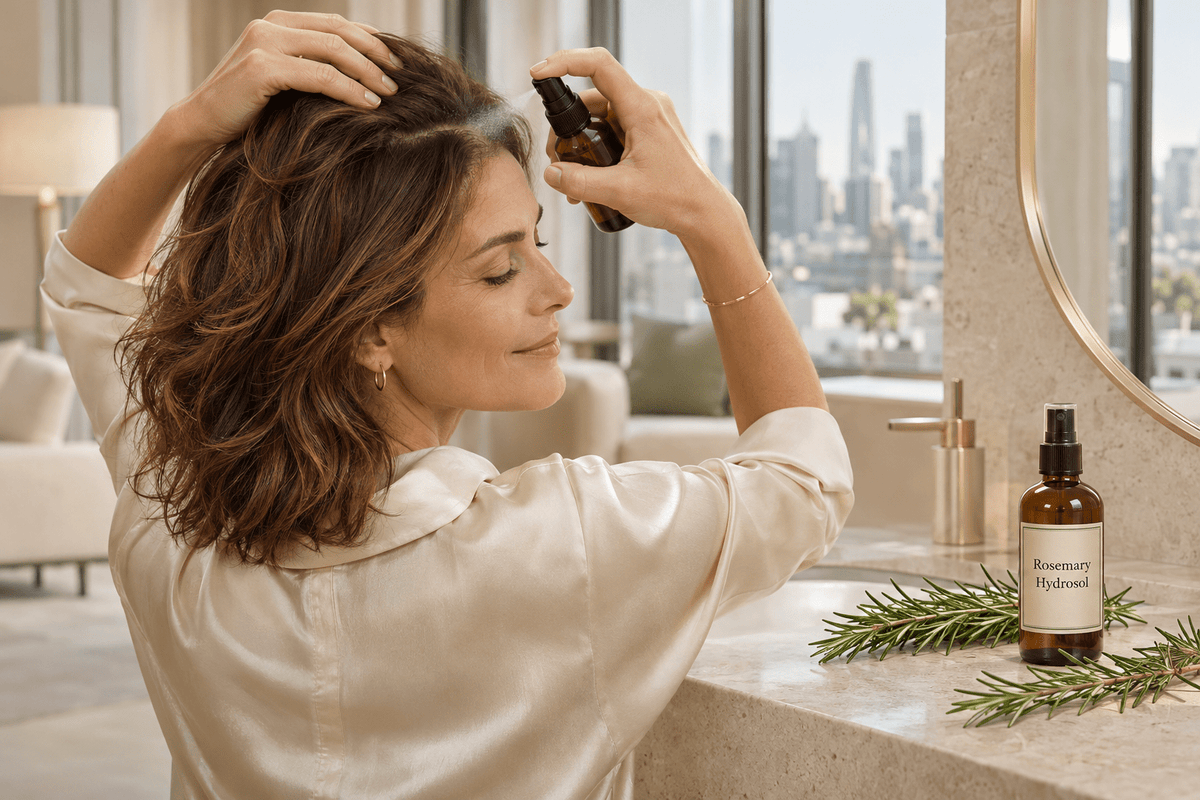
A few sprigs of rosemary, a saucepan, and a spray bottle. This viral recipe is everywhere on social media. If you notice excess hair shedding, trying an inexpensive home remedy feels tempting.
A homemade rosemary infusion and a distilled rosemary hydrolat may look similar, but they are different preparations. A hydrolat captures aromatic compounds carried by steam during distillation, creating a light, ready-to-use product for scalp care.
That distinction is easily lost in the enthusiasm for “rosemary water”. Research on rosemary and its longstanding use in aromatherapy make it an interesting plant for hair care. To understand what each preparation offers, we need to look at what is inside the bottle.
Why rosemary works in clinical trials
Social media interest stems from a landmark 2015 study by Panahi et al. Researchers compared a standardised topical rosemary formulation with 2% minoxidil in 100 individuals experiencing androgenetic alopecia. After six months, both groups demonstrated statistically comparable increases in hair count. Crucially, the rosemary cohort experienced significantly less scalp itching and irritation than the minoxidil group. [1]
Laboratory research by Murata et al. clarifies the biological mechanism. Rosemary leaf constituents inhibit 5-alpha-reductase, the enzyme that converts testosterone into dihydrotestosterone (DHT), which triggers follicle miniaturisation. [2]
Furthermore, a 2024 trial demonstrated that topical rosemary extract matches 2% ketoconazole in soothing seborrhoeic dermatitis, effectively relieving persistent scalp itching and flaking. [3]
These studies validate rosemary, but they used precise, standardised extracts. Their clinical success cannot be transferred to a pot of grocery-store herbs boiled on a stove.
What boiling rosemary leaves behind
Boiling rosemary leaves creates a simple culinary infusion, which presents three major issues for the scalp:
- Evaporation of active terpenes. The key compounds that support microcirculation and block DHT, such as 1,8-cineole, borneol, and verbenone, are volatile. In an open pot, these aromatic fractions evaporate into room air with the steam. The remaining liquid holds mostly heavy tannins and pigments rather than active volatile fractions.
- Bacterial contamination. Fresh kitchen brews contain unpreserved organic plant sugars. Even inside a refrigerator, tap-water infusions grow bacteria and mould within two to three days. Spraying non-sterile water onto the scalp risks folliculitis and inflammation, which worsens hair loss.
- Heavy residue. Homemade infusions leave sticky plant starches that coat the hair roots and weigh down fine hair.
What makes an authentic rosemary hydrolat different
A genuine rosemary hydrolat is produced through slow artisan steam distillation, not simple boiling.
During distillation, steam ruptures the plant oil glands and condenses into two distinct fractions: concentrated essential oil and pure cellular water, which is the hydrolat.
An analysis of a rosemary verbenone (Rosmarinus officinalis ct. verbenone) hydrolat reproduced in Michel Faucon’s reference work measured an aromatic fraction of 1.94 g/L. Within that fraction, verbenone and myrtenol together accounted for 61.18%, alongside borneol (5.00%), geraniol (3.71%) and camphor (3.42%). These figures describe the analysed batch, rather than a fixed formula for every rosemary hydrolat. [5]
Rosemary hydrolat also has an established place in professional aromatherapy literature. Price and Price describe its use as a scalp friction rub for hair loss, linking this application to its circulation-stimulating properties. [6]
For everyday scalp care, a hydrolat also offers practical advantages:
- Light and easy to leave in. A pure hydrolat contains no added carrier oil, so it can be applied along the partings without the greasy finish of an oil treatment. There is no need to shampoo it out.
- Naturally acidic. Faucon gives a pH range of 4.5 to 6.0 for rosemary verbenone hydrolat, making acidity another useful part of its profile. [5]
- Ready to use. A professionally produced hydrolat saves the preparation and filtering involved in a homemade infusion. Careful production, packaging and storage remain important for its quality. [4]
Choosing a companion hydrolat
Rosemary can be used on its own or combined with another hydrolat according to what your scalp needs:
- Rosemary and Bay Laurel. Pairing rosemary with bay laurel (Laurus nobilis) hydrolat provides lymphatic drainage and clarifying antimicrobial support, clearing congested follicles.
- Rosemary and Lavender. If your scalp feels tight or itchy, blending rosemary with lavender (Lavandula angustifolia) hydrolat introduces immediate soothing relief.
- Rosemary and Sage. Sage (Salvia officinalis) hydrolat pairs well with rosemary for women experiencing hormonal hair thinning around perimenopause. [5]
Daily application guide
- Apply to clean roots. Section damp or dry hair, then mist the hydrolat directly onto the scalp surface. Moisten the skin lightly without soaking the lengths.
- Perform fingertip massage. Massage in gentle circles for 60 seconds to stimulate microcirculation and distribute active compounds around follicles.
- Leave in. Do not rinse out. Style your hair as normal.
- Remain consistent. Follicle cycles require patience. Apply once daily for three to six months to evaluate long-term shedding reduction.
- Store correctly. Keep your bottle in a cool place, away from direct sunlight, steam and radiators. For convenience, decant a small amount into a clean, dry amber-glass spray bottle and keep the main bottle in the refrigerator. Follow the expiry date and recommended period after opening.
Bringing rosemary into your daily routine
If you want rosemary in your routine without preparing a fresh infusion, a steam-distilled hydrolat offers a simple daily option. Apply it directly to the scalp, massage gently and leave it in. Start with rosemary, or explore the hydrolats discussed above to choose a combination for your scalp.
Explore the hydrolats discussed above
References
- Panahi, Y., Taghizadeh, M., Marzony, E. T. and Sahebkar, A. (2015). “Rosemary oil vs minoxidil 2% for the treatment of androgenetic alopecia: a randomized comparative trial.” SKINmed, 13(1), pp. 15–21.
- Murata, K., Noguchi, K., Kondo, M., et al. (2013). “Promotion of hair growth by Rosmarinus officinalis leaf extract.” Phytotherapy Research, 27(2), pp. 212–217.
- Sadati, M. S., Alesana, F., Hekmat, M. and Parvizi, M. M. (2024). “Efficacy of topical rosemary extract lotion versus topical 2% ketoconazole lotion in the treatment of seborrheic dermatitis: a double-blind randomized controlled clinical trial.” Dermatology Practical & Conceptual, 14(4), e2024242.
- Almeida, H. H. S., Fernandes, I. P., Amaral, J. S., Rodrigues, A. E. and Barreiro, M.-F. (2024). “Unlocking the potential of hydrosols: transforming essential oil byproducts into valuable resources.” Molecules, 29(19), 4660.
- Faucon, M. Traité d’aromathérapie scientifique et médicale, Volume 2, Les hydrolats. “Romarin à verbénone”, pp. 415–423.
- Price, L. and Price, S. Understanding Hydrolats: The Specific Hydrosols for Aromatherapy. A Guide for Health Professionals. Churchill Livingstone. Rosemary monograph, pp. 137–138.


Leave a comment
This site is protected by hCaptcha and the hCaptcha Privacy Policy and Terms of Service apply.